Agentic AI in 2026: The Guide to AI Agents, MCP and Agentic Coding


Table of Contents
Agentic AI is the evolution of artificial intelligence that stops answering questions and starts executing tasks: an AI agent receives a goal, decides the steps on its own, uses external tools (APIs, databases, your code) and works in a loop until it is done. If 2023 was the year of the chatbot, 2026 is the year of the agent. And this is not a lab fad: 80% of enterprise applications shipped or updated in the first quarter of 2026 already embed at least one AI agent, up from 33% in 2024.
In this guide I explain, with no fluff and from the developer trenches, what agentic AI really is, how an agent is built inside, why the MCP protocol became the key piece, what agentic coding is and —most importantly— when it makes sense for your business and when it does not.
What is agentic AI and how is it different from a chatbot?
A classic chatbot —even one as good as ChatGPT in conversation mode— does one thing: it takes a message and returns text. You read, decide and act. An AI agent flips that dynamic entirely:
- A chatbot answers. You ask “how do I upgrade Laravel?” and it explains the steps.
- An agent acts. You tell it “upgrade this project to Laravel 13” and it reads your
composer.json, runs the commands, runs the tests, checks the errors and fixes them — on its own, in a loop, until it works.
The underlying difference is autonomy: the agent forms a multi-step plan, executes it, observes the result and adjusts. It does not wait for an instruction for every step. That is why Gartner logged a 1,400%+ rise in multi-agent system inquiries in little over a year: it is the biggest paradigm shift since ChatGPT itself appeared.
Anatomy of an AI agent
Under the hood, almost every agent shares the same four ingredients:
- A model (the brain). An LLM like Claude, GPT or Gemini that reasons and decides the next step.
- Tools (the hands). Functions the model can call: query your database, hit an API, read a file, send an email. Without tools a model only talks; with them, it acts.
- A loop (the engine). The agent thinks → uses a tool → observes the result → thinks again. It repeats until the goal is met or a limit is reached.
- Memory and context. The history of what it has done, plus the relevant data injected each turn.
The detail that matters for anyone building (or paying for) an agent: each turn of the loop is a model call, and every call costs tokens. An agent makes 3 to 10 times more calls than a chatbot for the same task, so cost control stops being optional. Before putting an agent in production, run real numbers with the AI cost calculator.
MCP: the protocol that connects agents to the world
Throughout 2024 everyone wired their agent to their tools by hand: a different glue for each API, each database, each app. That does not scale. The solution that won is MCP (Model Context Protocol), an open standard —created by Anthropic— so any agent can talk to any tool or data source the same way. Think of MCP as the “USB-C of AI”: a single connector instead of a thousand proprietary cables.
In 2026 MCP is already the de facto standard. The numbers make it clear:
- More than 10,000 active public MCP servers (Anthropic figure, December 2025).
- Native support in ChatGPT, Claude, Cursor, Gemini, Microsoft Copilot and VS Code.
- Over 97 million monthly downloads of its Python and TypeScript SDKs.
- OpenAI officially adopted it in March 2025, and in December 2025 Anthropic donated MCP to the Linux Foundation (Agentic AI Foundation), alongside Block and OpenAI: it is no longer owned by a single company.
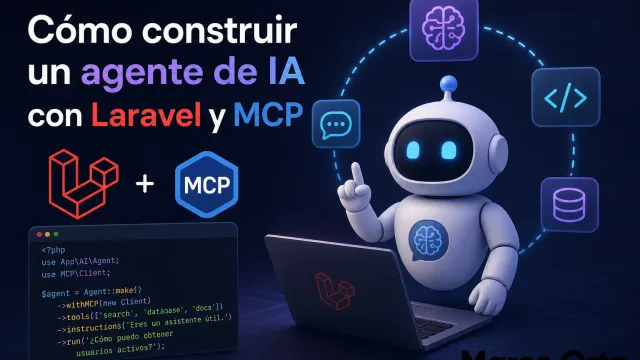
For a developer this is great news: you expose your business logic once as an MCP server and it becomes available to Claude, Cursor and any other agent. If you want to see it in code, I have a step-by-step guide on how to build an AI agent with Laravel and MCP.
Agentic coding: programming with agents in 2026
The first place agentic AI became everyday was software development itself. Agentic coding is programming by delegating whole tasks to an agent instead of asking for isolated autocompletions:
- Claude Code, Cursor and GitHub Copilot’s agent mode no longer just suggest lines: they read your repo, edit multiple files, run commands, run the tests and iterate until the change works.
- The developer shifts from writing every line to directing and reviewing: you describe the goal, the agent proposes and executes, and you validate.
This multiplies productivity, but it has a flip side. When an agent writes code at full speed it is easy to slip in vulnerabilities or bad practices if no one reviews. That is where discipline comes in: read my guide on secure vibe coding so you do not introduce security holes by trusting the AI too much.
What an AI agent can do for your business
Beyond code, this is where agentic AI creates real value for a small business or an enterprise:
- 24/7 customer support that not only answers but checks an order status, books an appointment or opens a ticket. A concrete example: an AI agent on WhatsApp for your business.
- Back-office: reading invoices, sorting emails, updating your ERP, generating reports — repetitive tasks that eat hours today.
- Sales and lead capture: qualify prospects, answer questions and pass only what is worth it to a human.
And it works: 66% of companies already using agents report measurable productivity gains. The agentic AI market went from around $7 billion in 2025 to nearly $10 billion in 2026, on its way to $57 billion by 2031. If you want to explore what to automate in your operation, take a look at my AI automation service for businesses.
The risks: why 40% of projects get canceled
It is not all enthusiasm. Gartner predicts that more than 40% of agentic AI projects will be canceled before the end of 2027. The reasons repeat:
- Runaway costs. Agents make many model calls; with no limits and no measurement, the bill explodes. (Again: calculate your costs first).
- Unclear business value. An agent gets built because “we have to do AI”, not to solve a concrete problem. Start with the problem, not the technology.
- Insufficient control and security. An agent with access to your systems and no guardrails is a risk. It needs scoped permissions, human approval for sensitive actions and auditing.
The good news: the other key data point is that today almost four in five companies have tried agents, but only one in nine runs them in production. There is a huge gap between “experimenting” and “actually working” — and that is exactly where a well-built implementation makes the difference.
How to get started with AI agents (without burning your budget)
- Pick a boring, repetitive problem, not the flashiest one. The best first agent solves something measurable (answering the 20 most common questions, sorting emails).
- Start with a small model. A “flash/mini” GPT or Gemini handles most tasks at a fraction of the cost; move up only if you truly need to.
- Give it scoped tools via MCP, with minimal permissions and human approval for anything irreversible.
- Measure from day one: tokens, cost per task and success rate. If you do not measure it, you do not control it.
- Iterate. The first agent is rarely the good one; the value is in tuning the loop.
If you come from PHP, you have two natural entry points: integrating the OpenAI API with Laravel for the first contact, and building an agent with Laravel and MCP for the agentic step.
Conclusion
Agentic AI is not science fiction or a future promise: in 2026 it is already inside most enterprise software, MCP gave it a standard to connect to everything, and agentic coding changed the way we program. But mindless enthusiasm is expensive: 40% of projects get canceled over costs, lack of focus and weak controls.
The recipe is the same as any well-done technology: start with a real problem, measure, scope and iterate. Do that, and an agent stops being an expensive experiment and becomes a digital employee working 24/7.
Want to explore what an agent could automate in your business? Let’s talk: take a look at my AI automation service for businesses and tell me which process is stealing your hours.
Found it useful? Get the next one by email
Once a week: what breaks when you upgrade, AI for developers and what I'm building, with sources. No spam.
By subscribing you accept our privacy policy.