Meta Banned General-Purpose AI Chatbots on WhatsApp: What It Means for Your Business (and What It Doesn't)

Table of Contents
Since January 15, 2026, you can no longer talk to ChatGPT, Copilot or Perplexity on WhatsApp from most of the world. A lot of people read that as “Meta banned AI bots”, and articles are circulating that warn businesses their numbers will be suspended for using AI. That isn’t what happened. Meta’s rule targets companies that offer a general-purpose AI assistant as the product, not businesses that use AI to serve their own customers. That is still allowed, and Meta’s own documentation says so.
What does change for a business are three other things, none of them about the ban. From October 1, Meta charges for customer-service replies, AI replies included, beyond 1,000 a month. Meta now sells its own AI agent for businesses. And the terms are being reorganized on September 23. Each one is below with its source. One caveat up front: in the European Economic Area and Brazil, regulators forced Meta to carve out an exception, so the ban applies everywhere else, including Mexico, the US and the rest of Latin America.
What the rule says, word for word
The clause is in the WhatsApp Business Solution Terms (last modified March 6, 2026), under “AI Providers”:
Providers and developers of artificial intelligence or machine learning technologies, including but not limited to large language models, generative artificial intelligence platforms, general-purpose artificial intelligence assistants, or similar technologies as determined by Meta in its sole discretion (“AI Providers”), are strictly prohibited from accessing or using the WhatsApp Business Solution, whether directly or indirectly, for the purposes of providing, delivering, offering, selling, or otherwise making available such technologies when such technologies are the primary (rather than incidental or ancillary) functionality being made available for use.
And two sentences later comes the one that matters to a business:
Notwithstanding the foregoing, you may retain an AI Provider as your Third Party Service Provider in accordance with these WhatsApp Business Solution Terms.
In other words: OpenAI can’t use WhatsApp to offer you ChatGPT. Your business can hire OpenAI (or anyone else) so its model answers your customers about your business. Meta’s pricing documentation is blunt about it: service messages “can be powered by a person, like a customer service representative, or by a 3rd-party AI solution.” And the European Commission, when it opened its investigation, put it the same way: businesses may still use AI tools “for ancillary or support functions, such as automated customer support offered via WhatsApp.”
The rule applied to new providers from October 15, 2025 and to existing ones from January 15, 2026, according to the European Commission.
Who left WhatsApp (and who came back)
| Assistant | What happened |
|---|---|
| ChatGPT | It had more than 50 million users on WhatsApp. It left on January 15; OpenAI asked people to link their accounts because conversations wouldn’t transfer (OpenAI). It came back on July 13, for European numbers only (release notes) |
| Microsoft Copilot | Left on January 15, without keeping chat history |
| Perplexity | Announced it was shutting down its WhatsApp number |
| Luzia | Big in Spain and Latin America. Moved users to its own app, and on June 30 launched a new WhatsApp assistant on a Spanish number, which fits the European exception |
| Meta AI | Stays. Since January 15 it has been the only AI assistant available inside WhatsApp, according to the European Commission |
Why ChatGPT is back in Europe and Brazil
Because regulators there made Meta back down, and the current version of the clause now includes the exception: general-purpose AI may be offered to users whose numbers have a European Economic Area or Brazil country code.
| Date | What happened |
|---|---|
| Dec 24, 2025 | Italy’s competition authority (AGCM) orders the terms suspended in Italy (AGCM) |
| Jan 12, 2026 | Brazil’s CADE opens an inquiry and suspends the terms as a preventive measure (CADE) |
| Feb 9, 2026 | The European Commission, investigating since December 4, sends its Statement of Objections |
| Mar 4, 2026 | Meta lets rivals back in within Europe, but charges them per message |
| Apr 23, 2026 | CADE upholds a daily fine of 250,000 reais because Meta was charging chatbots (CADE) |
| Jun 9, 2026 | The European Commission orders free access restored within five working days (Commission); Meta says it will appeal |
Outside those two regions nothing comparable has happened. In Mexico, the new National Antitrust Commission, which replaced COFECE in October 2025, hasn’t published any investigation of these terms.
What your business can still do with AI on WhatsApp
Everything that is serving your customers about your business: answering hours and prices, recommending products from your catalogue, booking appointments, taking orders, sending a payment link, following up. With three conditions that come from Meta’s own documents:
- There has to be a way to reach a person. The WhatsApp Business Messaging Policy allows automated replies but requires “prompt, clear, and direct escalation paths”: a human agent in the chat, a phone number, an email, a support form or a store visit. A bot that never lets anyone talk to a human breaks the policy, even though that has nothing to do with the AI clause.
- Conversations can’t be used to train other people’s models. The terms forbid using your customers’ data to create or improve AI systems, except a model fine-tuned for your exclusive use. Ask your vendor whether it trains on your data: OpenAI, for instance, says that on its API it does not train on it by default.
- The bot talks about your business. The grey zone is a number whose main offering is “ask me anything”, even if a shop runs it. Meta hasn’t published where “primary” ends and “ancillary” begins, and it reserves the call to its “sole discretion”. A bot that answers about your store is clearly on the allowed side; a ChatGPT with your logo that also helps with homework is not.
A note on what’s circulating: I found no documented case of a business number being suspended under this clause. The articles that talk about “mass suspensions” don’t cite any.
And if what you want is more customers messaging you, that doesn’t depend on AI: a QR code that opens your chat with a message already typed, on the counter or the receipt, works from day one.
What does change for you (and has nothing to do with the ban)
1. From October 1, service replies are billed
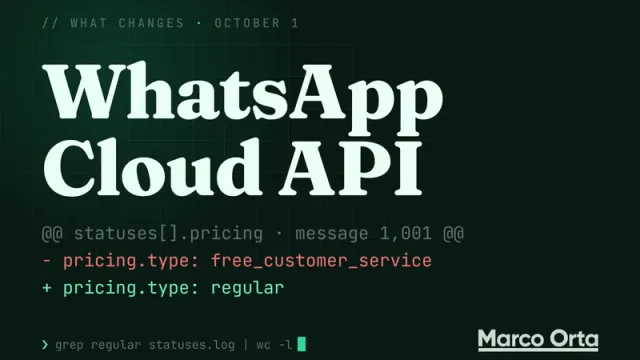
According to Meta’s pricing page, from October 1, 2026 service messages (your replies when the customer writes first) are charged at the same rate as utility messages, with 1,000 free per phone number per month, not rolled over. AI replies are service messages, so they count exactly like a person’s. And if your account has no payment method on file by September 30, Meta stops delivering your replies from the 1,001st of the month. The technical detail, including what changes in the webhook, is in what changes in your code on October 1.
2. Meta now sells its own AI agent
On June 3 Meta announced Meta Business Agent, and it promises a lot: answering questions about your business, recommending products from your catalogue, booking appointments, qualifying leads and closing sales. Getting started is free, but Meta has said access will move to paid subscriptions. On the API it has been billed since August 1 at $2 per million tokens, which Meta estimates at about 4 to 5 US cents per message. And on September 15 it introduced Meta One, with a plan starting at $14.99 a month that includes more use of the agent; pricing and availability vary by region.
The question isn’t whether it’s good, but whether you want your customer service to depend on the rules and prices of the same company that owns the channel, which is exactly what regulators in Europe are investigating.
3. The terms are being reorganized on September 23
That day WhatsApp splits its terms into two documents, one for the WhatsApp Business app and one for the platform (the API). Its help center describes it as a reorganization, but the new text isn’t published yet. I’ll check it when it is and update this post if the AI clause changes.
Meta’s agent, or one connected to your business?
It depends on what you need it to do:
| Meta’s agent | Your own agent on the API | |
|---|---|---|
| Setup | From the app, in minutes | Days or weeks |
| Where its answers come from | Your catalogue and what you configure in Meta | Your systems: inventory, calendar, payments |
| Which model | Meta’s | The one you choose, with a no-training guarantee |
| What you pay | Meta’s tokens or subscription, plus messages | Meta’s messages plus the model you use |
| Rules and prices | Meta decides | Messages: Meta. Everything else: you |
For a business that sells what’s in its catalogue and answers repeated questions, Meta’s agent may be enough. When the answer depends on something that lives outside Meta (whether it’s in stock today, whether the doctor has a free slot, what shipping costs to your neighbourhood), you need one connected to your own systems. That’s how the AI automation I build for businesses works, and I covered the technical side in building an AI WhatsApp agent for small businesses with Laravel and OpenAI.
Five questions to ask your bot vendor
- Does my number use the official WhatsApp API or an unofficial app? (Unofficial ones can be blocked by Meta even without AI.)
- Does the bot answer only about my business, or anything at all?
- How does a conversation get handed to a person, and how fast?
- Are my conversations used to train any model?
- Does my Meta account have a payment method before September 30, and who pays for messages beyond 1,000 a month?
If any answer is “I don’t know”, that’s the one to fix first.
Frequently asked questions
Did Meta ban AI chatbots on WhatsApp?
It banned AI providers from offering general-purpose assistants (like ChatGPT, Copilot or Perplexity) through the WhatsApp Business API when AI is the primary functionality of the service. It applies from January 15, 2026 for existing providers and from October 15, 2025 for new ones. It did not ban businesses from using AI to serve their own customers.
Can my business use an AI chatbot on WhatsApp in 2026?
Yes. WhatsApp's terms let a business retain an AI provider as its third-party service provider, and Meta's pricing documentation says service messages can be powered by a person or by a third-party AI solution. The conditions: a clear way to reach a person, conversations not used to train other companies' models, and a bot that serves customers about your business.
Why does ChatGPT work on WhatsApp in Europe but not in Mexico or the US?
Because Italy's competition authority, the European Commission and Brazil's CADE ordered Meta to suspend the restriction, and the current terms (dated March 6, 2026) allow general-purpose AI for numbers with a European Economic Area or Brazil country code. ChatGPT returned to WhatsApp in Europe on July 13, 2026. Everywhere else the restriction still applies.
Can my WhatsApp number be suspended for using AI?
Meta can close accounts that break its terms, and it decides at its sole discretion where AI stops being ancillary and becomes the primary functionality. A bot that serves customers about your business is on the allowed side; a number whose main offering is a general question-answering assistant is at risk. There are no documented public cases of business numbers suspended under this clause.
How much does Meta's AI agent for businesses cost?
Meta Business Agent was announced on June 3, 2026 and getting started is free, but Meta has said access will move to subscriptions. On the API it has been billed since August 1, 2026 at $2 per million tokens, about 4 to 5 US cents per message according to Meta. The Meta One plan introduced on September 15 starts at $14.99 a month and includes more use of the agent; price and availability vary by region.
Are AI chatbot replies on WhatsApp billed?
From October 1, 2026, yes, like any service message: Meta gives 1,000 free per phone number per month and charges the rest at each country's utility rate. It makes no difference whether a person or an AI replies. If the account has no payment method, Meta stops delivering replies from the 1,001st of the month.
Found it useful? Get the next one by email
Once a week: what breaks when you upgrade, AI for developers and what I'm building, with sources. No spam.
By subscribing you accept our privacy policy.